08
Jan
2026
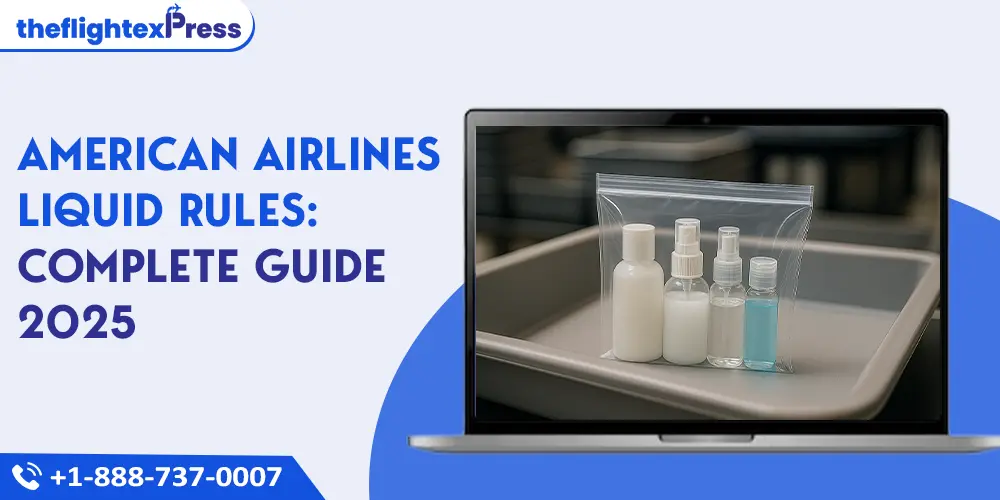
Table Of Content
Indeed, the aspect of travelling with liquids is actually baffling, particularly when there are changes in policy at different times and different rules apply to all the airlines and all the airports. Therefore, when you are flying American Airlines in 2025, a breakdown of the liquid policy can make you have an easy time going through the security line without the feeling that you are going through the security line at the last moment and have to re-pack your luggage. American Airlines liquid limit is based on the usual TSA liquid rules on U.S departures, which is aware of what you can carry in your carry-on Vs the checked baggage, and as a result, guarantee you and all the other travelers a better and more prepared experience of travelling.
This guide here offers a clear and easy-to-follow explanation of American Airlines' liquid rules for 2025. Here, the main goal is to simplify what you need to know before packing, which includes the basic allowances, restrictions, and helpful tips for a smooth check-in and security process at the airport.
Like, when you are getting ready to fly with American Airlines, then it becomes more important to know in detail, but it can make a big difference in how smoothly your trip begins. We are all well aware that the security checkpoints are often where the delays take place, and most of these slowdowns are caused by the passengers who are carrying liquids that don?t meet the required guidelines.
Just like any other airline, American Airlines also follows the standard policies of the TSA for liquids on all U.S departures, which implies that travelers carrying liquids must follow the set standard limitation of carrying the liquids. This knowledge will prepare you for a smoother boarding, reduce last-minute tensions at the airport, and which might disturb you enjoy your journey further. The overview of TSA 3-1-1 Rule for Liquids will help you to travel with confidence.
On American Airlines, the carry-on liquids are subject to the Standard Transportation Security Administration (TSA) 3-1-1 Rules. This implies that every passenger has to carry the liquids, creams, gel, and aerosols in containers of 3.4 ounces or less. All such containers must be fitted inside a single clear, quart-sized plastic bag. Here, each and every passenger can bring along one carry-on bag following the
Furthermore, certain liquids are allowed, such as the baby formula, breast milk, and duty-free purchases?though these may have to be declared at the security. And here, such items often require a separate screening option as well.
In case if the traveler fails to comply as per the liquid rule, for instance, by carrying containers larger than 3.4 ounces in your carry-on or more than one plastic bag of liquids, then your stuff may need to be confiscated at the security checkpoint. So, by following the 3-1-1 rule, you can ensure a smooth security screening and avoid delays during boarding the flight.
What Counts as a Liquid?
Many travelers might think only of water or beverages, but the definition is much deeper and broader. The security agencies here help you to categorize the liquids as any such substance that can be spread, poured, squeezed, or sprayed. This includes the common items such as creams, lotions, gels, pastes, perfumes, oils, hand sanitizers, and liquid cosmetics.
Also, the product that may appear to you as solid but which has a semi-liquid texture also falls under the liquid regulations. Examples are peanut butter, yogurt, jelly, mascara, vapor inhalers, shaving foam, hair sprays, and sunscreen sprays are also included, as they also release liquid when used.
Allowed vs. Prohibited Liquids
Below is a clear breakdown of the many liquids that you can and cannot bring on an American Airlines. As mentioned earlier, the airline here follows the TSA rules, and this table will help you to understand better all the needfuls on American Airlines liquid policy at your fingertips:-
|
CATEGORY |
ALLOWED IN CARRY ON (under 3.4 oz) |
ALLOWED IN CHECKED BAG |
NOT ALLOWED/PROHIBITED |
|
Water, Drinks & Beverages |
Yes |
Yes |
Over 3.4 oz in the carry-on |
|
Toiletries (shampoo, lotion, perfume) |
Yes |
Yes |
? |
|
Baby Formula/Breast Milk |
Allowed under reasonable quantities |
Yes |
? |
|
Medications (liquid) |
Allowed with a declaration |
Yes |
? |
|
Aerosols (deodorant, hairspray) |
Under the 3.4 oz |
Limited quantity |
Flammable aerosols |
|
Food items like yogurt, soups, spreads |
Under 3.4 oz |
Yes |
Containers over 3.4 oz |
|
Bleach, Corrosives, Toxic liquids |
Not allowed |
Not allowed |
Prohibited |
|
Flammable Liquids |
Not allowed |
Not allowed |
Prohibited |
These tips will help you plan and pack your bag as per the guidelines of the TSA Rules. For more information, get in touch with theflightexpress.
The liquid rules that you deal with at the security do not apply to the checked bags. So, if you desire to pack teh full-size bottles like wine, shampoo, conditioner, mouthwash? then go for them. The TSA doesn?t have any limit imposed on your checked baggage.
Liquids in Checked Luggage: What You Can Bring
Know that the checked bags are far more flexible than carrying liquids when compared with the carry-ons. You can pack a full-size toiletries, large shampoo bottles, beverages, and more food items without thinking about the 3.4 oz limitations.
Restrictions on Flammable or Hazardous Liquids
The liquid should be sealed and preferably placed in the leak-proof bags to prevent them from damaging other items. While most everyday liquids are allowed, the hazardous items like bleach, corrosives, and other toxic chemicals are not permitted. Aerosols like hairspray and deodorant are allowed to be brought in, but in limited quantities as long as they are not allowed in limited quantities as long as they are marked ?flammable?. Here, packing the liquids ensures safety and helps avoid damage to your belongings.
American alcohol rules for checked baggage say that it's allowed, only till the time it meets the federal regulations. The alcohol with 24 % alcohol content or less (beer or wine) has no quantity limits here, while the other liquor between 24 % and 70 % alcohol is limited to 5 liters per passenger, and it must be sealed and in an unopened retail packaging. The drinks here are over 70% alcohol are prohibited. Make sure that the bottles are well-packed so that there is no spillage.
Tip: Always go through the destination country restrictions before travelling.
Bringing Alcohol Purchased at Duty-Free
In case you buy alcohol at a duty-free shop before flying, the traveler can bring it on board without any problem with checking. The key factor here is that the alcohol must be sealed in the tamper-evident duty-free bag that is provided on purchase. Also, the traveler here has to keep the receipt handy as the security department may request you to show them the proof of purchase within 48 hours. And if you have a connecting flight in the U.S., the alcohol may need to be placed in your bag after customs.
Alcohol Percentage Limits (ABV Regulations)
|
ALCOHOL TYPE/ABV RANGE |
ALLOWED IN CARRY-ON |
ALLOWED IN THE CHECKED BAGGAGE |
RESTRCITIONS |
|
24% -70 % ABV for most spirits like rum, vodka, and whiskey. |
Only if it is duty-free sealed |
Yes |
Must be in an unopened retail packaging. |
|
Under the 24 % ABV (beer, wine, low-alcohol drinks) |
Yes and it must follow the 3.4 oz limits unless its duty-free |
Yes |
No special limitations. |
|
Above 70% ABV, which has a high-proof alcohol, grain spirit |
Not Allowed |
Not Allowed |
Fully prohibited in all baggage. |
Passengers may carry medically necessary liquids, gels, and medications as well, such as cough syrup, insulin, or saline, and there are no size restrictions as long as they are declared at the security point to the airline officials.
Baby Formula, Breast Milk, and Medications
Parents can bring their baby's food, like formula, breast milk, and juice, but in reasonable quantities for the duration of the flight. These many items do not fit inside the quart-sized bags but have to be separated for screening.
How to Declare Medical Liquids at Security
The process is simple and also it makes sure that there is a smooth screening process. As you get to the TSA checkpoint, remove all the medically reasoned liquids like the prescribed medicines, liquid nutrition, or saline solutions, and put them in a separate tray only. Let the TSA official know that you are carrying medical liquids that are beyond the limit of 3.4 oz. The items here do not need to be fitted inside your quart-sized bag but must be screened individually. Here, you should know that the officials may conduct additional checks, such as swabbing the container. So, make sure that you have kept the medications nicely labelled and easily accessible, which will help to speed up the process and avoid delays.
Traveling with American Airlines on an international route, the liquid regulations are typically based on the rules of TSA at the U.S. airports, i.e., the 3-1-1 rule is applied to all liquids carried as carry-ons unless an exception. International flights can, however, have other screening in the connecting airports, or local security regulations can be different. Liquids that are bought in other countries should still be in tamper-evident bags, and they should carry receipts in order to be easily passed through connecting checkpoints. There are even countries that have a stricter ban on goods such as aerosols or medication, and thus, a traveler can expect to undergo secondary checks. The liquid regulations on checked baggage are not any different, whereby quantities of the same may be added provided they are non-hazardous.
Customs and Duty-Free Guidelines
Duty-free liquor, like alcohol and perfumes, should be packed in tamper-evident cases and must have a proper receipt. You are required to make a declaration of any duty-free purchases that would be in excess of the allowable limits of the country once you have arrived. A number of nations have particular prohibitions on the amount of alcohol, tobacco, and high-value items. Even when you are flying to a different airport, the duty-free liquids might have to be put in the baggage after customs. To save time at customs and not to have to pay extra taxes or fines, it is always good and easy to follow these guidelines.
Liquid Regulations by Destination Country
You should keep in mind that liquid regulations at your destination could be different than the TSA ones. The 3-1-1 provision is used when departing the U.S, but most foreign airports have guidelines. Certain nations have more stringent restrictions of goods such as aerosol cans, large-sized liquid containers or duty-free imports in case of a transfer. Security checkpoints in places like the EU, U.K., Australia, and some parts of Asia can make a person re-screen all liquids, even those in airtight and closed duty-free packages. It is always advisable to keep receipts and tamper-evident bags. It is better to check the local airport regulations beforehand to avoid any time wastage and confiscations.
In American Airlines liquid limit, it is the Transportation Security Administration (TSA) that establishes the regulations, not American Airlines. TSA sets national security standards in the United States airports, such as the 3-1-1 liquid rule, according to which carry-on liquids should be contained in 3.4-ounce containers packed in a quart-size bag. American Airlines is not the one that makes these regulations, but complies with and implements them at security checkpoints. The airline can offer guidance or clarification, but the ultimate decision is made by TSA officers as they screen. Being aware of this difference will guide travelers to know that the liquid limit is a universal standard used by all airline companies and that they effectively observe the same safety measures for all passengers in the United States.
Recent Blogs
Frequently Asked Questions?
No. Passenger are not allowed to carry a full water bottle through the security as per the TSA Regulations.
Yes, you can. But it must adhere to the TSA's 3-1-1 liquid rule: containers should be 3.4 ounces (100 ml) or less, and they all need to fit into one clear quart-sized bag. Though larger perfume bottles can be included in your checked baggage, they must be packed securely to avoid leaks.
Indeed, you can take alcohol on the AA flight, but with restrictions on alcohol content and quantity. Alcohol with an ABV of over 70 % ABV (140 proof) is prohibited. In your carry-on, the containers should be 3.4 oz or even less and in a quart-sized bag.
With American Airlines, infants under the age of two can fly on an adult's lap for a fee on international flights, while this is free on domestic flights. Traveling infants younger than seven days must have a doctor’s note that clears them for travel. Whether for flights within the country or those crossing borders, only one infant per adult may sit on a lap, and once a child turns two, they must have their own seat.
In accordance with the TSA's 3-1-1 rule for liquids in carry-on luggage: containers must not exceed 3.4 ounces (100ml), all containers must fit within one clear, one-quart zip-top bag, and each passenger is allowed only one such bag. Liquids, gels, and aerosols in amounts greater than the specified limit must be placed in checked luggage. There are exceptions for fluids that are medically essential, infant formula, and breast milk; these should be announced at the checkpoint.
American Airlines adheres to the TSA's 3-1-1 rule for carry-on liquids on all flights, including those that are international. All liquids, aerosols, gels, creams, and pastes should be stored in containers that do not exceed 3.4 ounces (100 milliliters). All of these containers must be placed into one clear quart-sized (1-liter) resealable plastic bag, and each passenger is allowed only one bag